Phaetus Liber High-Flow Hotend for the Snapmaker U1 (and the Hydra Toolhead System)
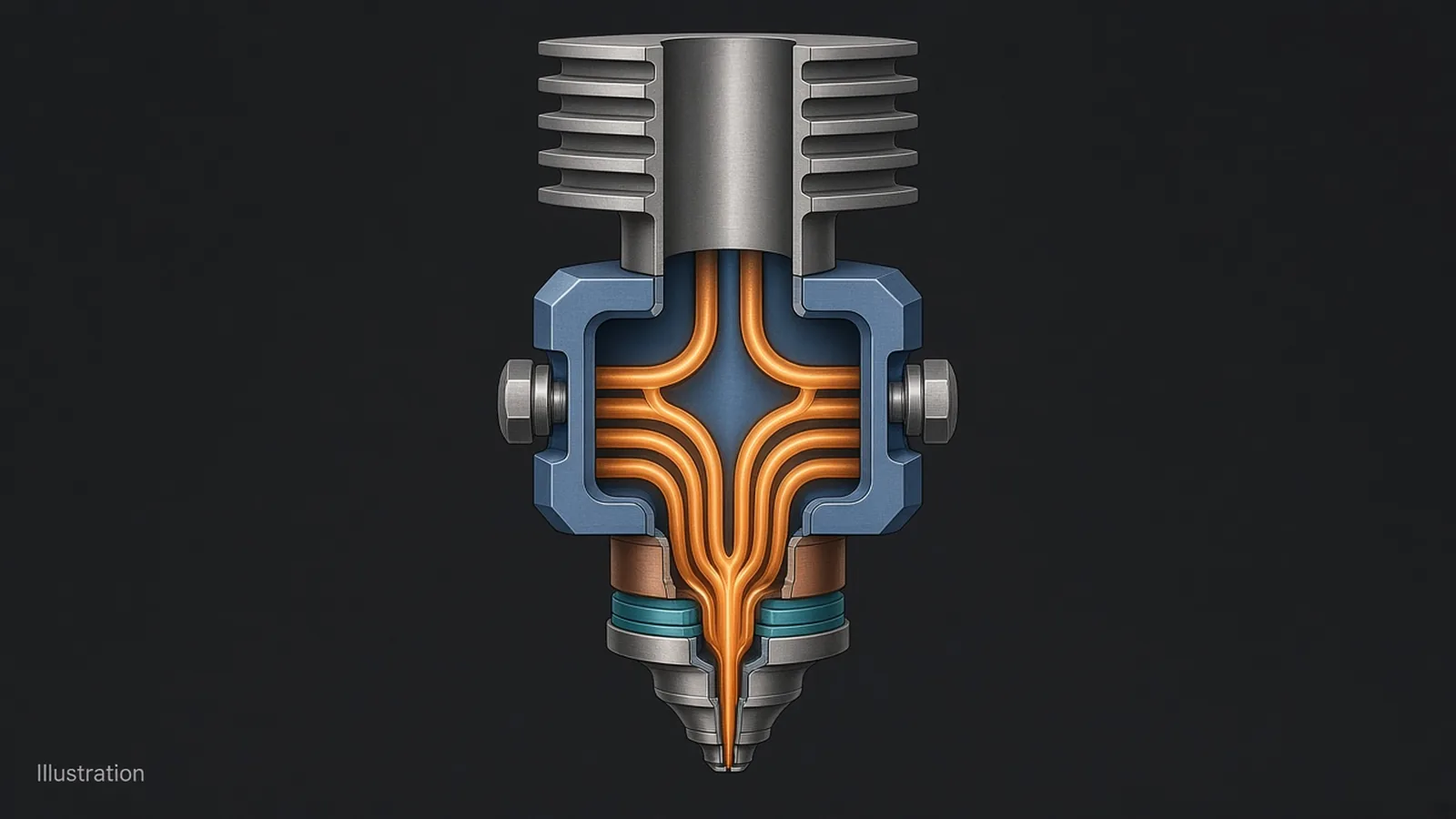
Short answer: The Phaetus Liber is a complete high-flow hotend for the Snapmaker U1, rated at 55 mm³/s and up to 300°C, with a 0.4 mm hardened-steel nozzle coated in DLC. On 19 November 2026 Snapmaker's store listed one at $34.99 and a four-pack at $99, and the 87% flow gain on the box is a single lab test, not a promise that prints finish 87% sooner. Hydra is a separate Phaetus toolhead switching system that has only been teased: no tool count, compatible printers, price or ship date have been published.
Updated 19 November 2026, during Formnext. Prices were checked on Snapmaker's and Phaetus's official stores that evening, Oslo time. Snapmaker sent me the U1 I use and has no say over what I write; there is no Liber test of my own in this article yet, so every flow and time figure below is the maker's.
On a big, smooth print, a fast printer ends up waiting on its hotend. The U1 can move at up to 500 mm/s, but a nozzle only melts so much plastic per second, and that number caps everything else.
Liber is Phaetus's attempt to raise that cap on the U1, built with Snapmaker and sold by both. It was announced in September and sat on the Phaetus stand at Formnext this week, next to a much vaguer product called Hydra.
This piece covers Liber first, because it is a real part with a spec sheet and a price. Hydra gets the section it has earned so far: what Phaetus has said, and the much longer list of what it has not.
A 24-gram hotend that fits one printer
Phaetus does not hedge on compatibility. The product page lists one model: the Snapmaker U1.
| Spec | Phaetus Liber |
|---|---|
| Compatible printer | Snapmaker U1 only |
| Max flow rate | 55 mm³/s |
| Nozzle | 0.4 mm, hardened steel with DLC coating |
| Heat break | Titanium alloy |
| Max printing temperature | 300°C |
| Size and weight | 48 × 26.5 × 15 mm, 24 g |
It is a complete hotend, not a nozzle swap, so it replaces the stock stainless-steel hotend in a U1 toolhead. The four-pack covers all four toolheads.
The hardened nozzle matters as much as the flow figure for some people. Hardened steel is what you want for abrasive filaments such as carbon-fibre blends. The 300°C ceiling keeps it inside the same temperature range as a standard U1.
If volumetric flow is a new term, it is the volume of plastic a hotend can melt per second, and it is the number that limits real print speed on large parts. My guide to 3D printer specifications explains how it relates to the mm/s figure on the box.
The 87% figure, and the test behind it
87% is the number on the box. Read the conditions before you read it as a speed-up.
Phaetus compares Liber with the U1's stock stainless-steel hotend "under our laboratory test conditions" and reports up to 87% higher volumetric flow. That test used Snapmaker ABS at 280°C on a 100°C bed in a 24°C room, at 1,000 mm/s² acceleration, as a single-wall spiral vase with 0.2 mm layers in an enclosed printer. The stock hotend ran the same test as the control.
Snapmaker's launch blog of 22 September breaks the same comparison out by material.
| Filament | Flow gain over the stock hotend (Snapmaker lab) |
|---|---|
| PLA | 66% |
| ABS | 87% |
| PETG HF | 43% |
So the headline is the best of three, on the material that gained most. The same blog says outright that the gain "doesn't mean every print will finish 87% faster."
Phaetus also publishes a print-time claim: one lab print went from 7 h 59 min to 3 h 50 min, 51.98% faster, in SnapSpeed PLA at 220°C on a 55°C bed. That is one model under one set of settings. Phaetus does not say it applies to yours, and neither do I.
When a high-flow hotend helps, and when it won't
A tall vase, a large enclosure panel or a big solid bracket spends most of its time laying long, unbroken lines. That is where the melt rate is the bottleneck, and where Liber's FAQ says it helps most.
A detailed figure is the opposite. Short moves and constant changes of direction mean the toolhead is braking and accelerating most of the time, so it rarely reaches the speed where the hotend runs out of melt. Phaetus's FAQ says the benefit is smaller on detailed models with frequent changes of direction.
Look at what you print most, not at the flow number. This is my rough sort, based on that FAQ line.
- Likely to gain. Large single-wall vases, big functional parts, batch prints of the same chunky part, anything printed with thick layers.
- Likely to gain little. Small multicolour figures, fine text, miniatures, and parts with many short perimeters.
- Depends on the profile. A hotend that can melt more only prints faster if the slicer is allowed to ask for more. The max volumetric speed setting has to go up too.
That last point is where calibration comes in. The max volumetric speed test in my guide to how to calibrate a 3D printer tells you what a hotend can actually do with one filament. Run it before and after, and you have your own number instead of the lab's.
Two rules in the small print that matter more than the flow
The spec sheet sells the part. The FAQ tells you how to live with it.
One nozzle diameter per print
Phaetus's FAQ says: "The U1 currently does not support using hotends with different nozzle diameters in the same print job." Liber only comes in 0.4 mm, so this matters if you own U1 hotends in other sizes.
In practice, every toolhead in one job has to run the same diameter. If you want to mix a Liber with stock hotends of the same 0.4 mm size, ask Snapmaker support before you plan around it, because the FAQ wording is about diameter, not brand.
Note the word "currently". Nothing published says whether or when that changes.
A cold pull after high-temperature filament
The FAQ also recommends a cold pull when you go back from high-temperature filaments to PLA or PETG. A cold pull is the usual way to clear the hotter material out of the nozzle before the cooler one goes through.
A new hotend is also a calibration trigger on the U1. Snapmaker's U1 FAQ lists a replaced hotend as a reason to run the multi-toolhead offset calibration again, which takes about 15 to 20 minutes, and its multi-colour printing guide lists a replaced nozzle or toolhead as a reason to level again.
Price, and two stores that disagree about stock
Same part, same four-pack price, two different stories about whether it is in stock. These are the figures from the evening of 19 November.
| Store | Single 0.4 mm | Four-pack | Note |
|---|---|---|---|
| Snapmaker official store | $34.99 | $99.00 (compare-at $119.00) | The clearer live offer |
| Phaetus US store | Not checked | $99.00 (was $119.00, −17%) | The page says both "In stock" and "This product will be available for sale in 2 weeks, but you can pre-order now to receive 10% discount!" |
I am not going to resolve the Phaetus wording for them. The Snapmaker store is the clearer offer, so that is the one I link.
Snapmaker's 22 September launch blog listed the four-pack at $119 and added that "actual pricing may vary by market." At $99, four singles at $34.99 each would cost $40.96 more than the pack, so if you are fitting all four toolheads the pack is the obvious buy.
There is no Amazon listing I could verify for Liber, so there are no affiliate links here.
Hydra: what Phaetus has said, and what it hasn't
Hydra has a name, a stand at Formnext and a handful of marketing lines. That is close to everything.
Phaetus's pre-show post calls it an Automatic Toolhead Switching System built for "multi-tool collaboration and flexible material switching", covering materials "from soft and flexible materials to rigid, fiber-reinforced applications." It ended: "More details about Hydra will be revealed at Formnext." As of the evening of 19 November, that line was still on the page.
The official teaser on X, posted on 13 November, adds four short claims.
- "Patented Extrusion System. Versatile Materials."
- "1-Second Hotend Switching."
- "High-Flow Performance. Powered by Liber."
- "Modular Design. Flexible Integration."
Phaetus's show-floor posts on 17 and 18 November call it a "new multi-head switching system" and say it is on the stand. They add nothing else.
What is still unknown
Nothing on phaetus.com yet answers the questions you would ask before buying.
- How many toolheads it holds, and how they dock.
- Which printers it fits, including whether the U1 is one of them.
- Firmware and slicer support.
- Price and ship date.
- How the 1-second figure was timed: there is no test method and no start or stop definition.
"Powered by Liber" ties Hydra's flow to Liber's hotend design. It does not say Hydra works with a U1, and I would not assume it does.
One more trap if you go looking: Phaetus's post titled "Phaetus Shenzhen at Formnext 2026" is about Formnext Asia in Shenzhen in August, not the Frankfurt show. I will update this section if Phaetus publishes a spec sheet after Formnext closes on 20 November.
Who Liber is for
If your U1 mostly prints small multicolour figures, keep the $99. The FAQ itself says detailed models gain least.
Liber makes sense if you already own a U1 and print large parts, vases or batches, or if you want hardened nozzles on all four toolheads for abrasive filaments. Expect to tune max volumetric speed per filament afterwards, or the slicer will never ask for the extra flow.
If you are still choosing a printer, Liber is not a reason to buy a U1 on its own. The case for the U1 as the multicolour and affordable toolchanger pick is in Snapmaker U1 vs Bambu Lab P2S, with the Bambu P2S as the single-colour pick. My recommended 3D printers list has both, and the toolchanger vs AMS guide explains why four separate hotends waste less filament than one shared nozzle.
The rest of the show is in my roundup of new toolchanger and multi-material printers at Formnext 2026, including the Snapmaker U1 vs Creality K3 comparison.
MakerViking has older Phaetus-related hardware pages too: the Mjolnir hotend assembly for the TwoTrees SP5 and Sapphire Plus and a Phaetus Dragonfly BMS mount for MGN12 on 2020 extrusion. Those are DIY builds for other machines. Neither is a Liber alternative.
Notes on the manufacturer numbers
None of these figures comes from an independent test. Here is where each one comes from.
- 55 mm³/s. Phaetus's rated max flow on the Liber product page.
- Up to 87% higher flow. Phaetus lab test, against the stock stainless-steel U1 hotend: 24°C ambient, 100°C bed, Snapmaker ABS, 280°C nozzle, 1,000 mm/s² acceleration, single wall, 0.2 mm layer, spiral vase, enclosed.
- PLA 66%, ABS 87%, PETG HF 43%. Snapmaker blog, 22 September 2026, for the same comparison. The blog adds that this "doesn't mean every print will finish 87% faster."
- 7 h 59 min to 3 h 50 min. Phaetus lab time test in SnapSpeed PLA at 220°C, bed 55°C, against the stock hotend. The result depends on the model.
- 1-second hotend switching. Phaetus marketing claim for Hydra, 13 November 2026, with no published test method.
FAQ
What is the Phaetus Liber hotend?
The Phaetus Liber is a complete high-flow hotend for the Snapmaker U1, made by Phaetus with Snapmaker. Phaetus rates it at 55 mm³/s and up to 300°C, with a 0.4 mm hardened-steel nozzle coated in DLC and a titanium-alloy heat break, and it weighs 24 g.
Does Liber fit printers other than the Snapmaker U1?
Liber is a U1-only part. The Phaetus product page lists the Snapmaker U1 as the only compatible model, and the hotend replaces the stock stainless-steel hotend in a U1 toolhead.
Does Liber make prints 87% faster?
The headline Liber figure is a flow gain in one lab test, not a print-time cut. It is up to 87% more flow in a single-wall ABS vase against the stock hotend, Snapmaker lists 66% for PLA and 43% for PETG HF in the same comparison, and its blog says the gain does not mean every print finishes 87% faster.
How much does the Liber hotend cost?
The price of a single Liber on Snapmaker's official store was $34.99 on 19 November 2026, and the four-pack was $99, down from $119. Phaetus's US store listed the four-pack at $99 with mixed in-stock and pre-order wording on the same page.
Can I mix Liber with other nozzle sizes on the U1?
The U1 is limited to one nozzle diameter per print job, according to the Liber FAQ: "The U1 currently does not support using hotends with different nozzle diameters in the same print job." Liber is 0.4 mm only, so every toolhead in that job needs a 0.4 mm hotend.
What is Phaetus Hydra?
Phaetus Hydra is an automatic toolhead switching system that Phaetus teased before Formnext 2026 and showed on its stand. The official teaser claims "1-Second Hotend Switching" and high-flow performance "Powered by Liber", but no spec sheet, tool count, price or ship date has been published.
Does Hydra work with the Snapmaker U1?
Hydra's printer compatibility is not published. Phaetus has not said which printers Hydra fits, and "Powered by Liber" describes its hotend, not a U1 mount.
Sources
Sources were checked on 19 November 2026.
- Phaetus US store: Snapmaker Phaetus Liber high-flow hotend for U1
- Snapmaker store: Liber high-flow hotend
- Snapmaker blog: Introducing the Snapmaker x Phaetus Liber high-flow hotend for U1, 22 September 2026
- Snapmaker: U1 FAQ
- Snapmaker Wiki: U1 multi-colour printing guide
- Snapmaker store: U1
- Phaetus: New technologies, new products, more possibilities (Formnext 2026 preview)
- Phaetus on X: Hydra teaser, 13 November 2026
- Phaetus on X: Formnext stand post, 17 November 2026
- Phaetus on X: Formnext stand post, 18 November 2026