BrokkrSculpt
Voxel sculpting that produces models a printer can actually use. Shape solid material, cut it with a plane that closes itself, export something that slices.
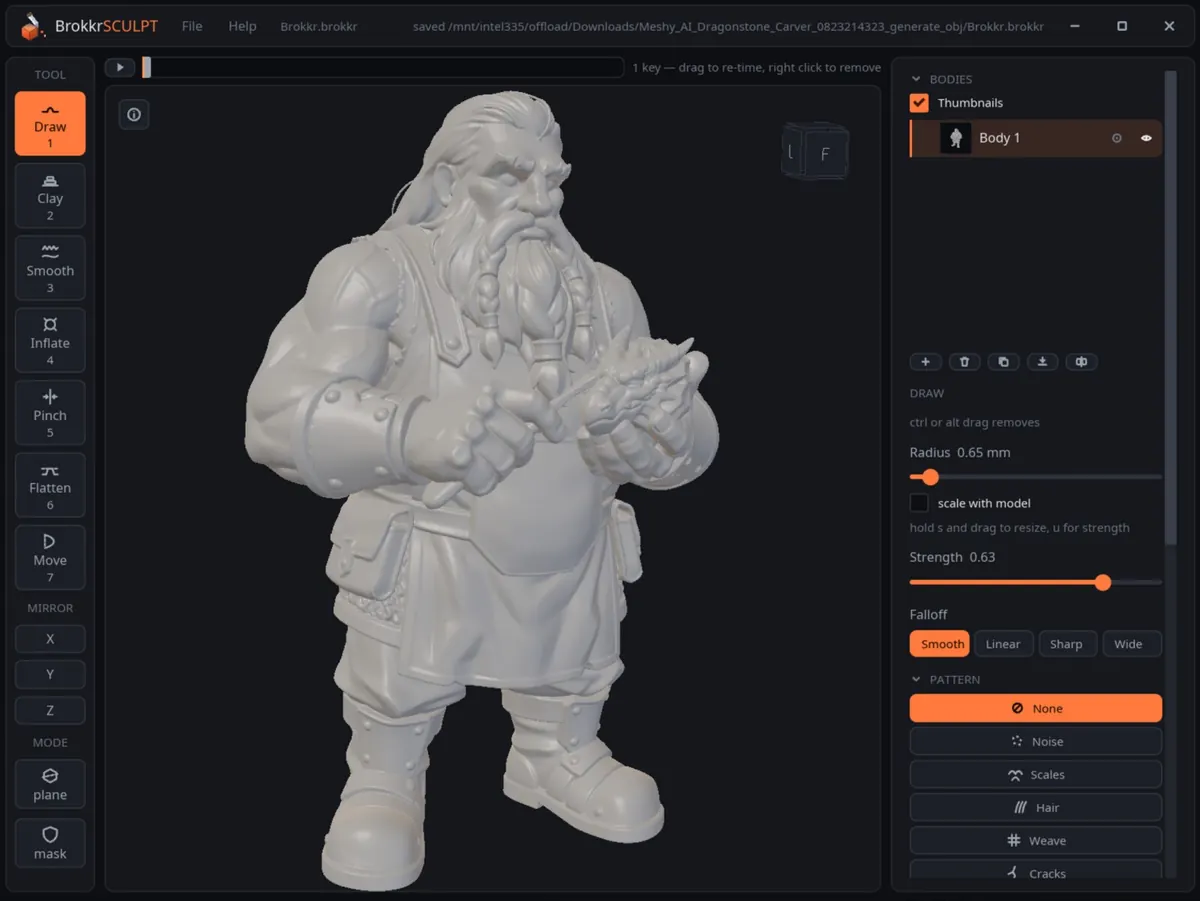
Sculpting tools were built to make pictures
Pull too hard on a mesh and the surface tears. In a render that costs you nothing, because a render is a photograph of a shell and nobody looks at the back of it.
It costs you the model when the thing has to leave a printer as one solid object. That is the mismatch at the centre of every sculpting tool aimed at animation and borrowed for printing.
Solid material instead of a surface
BrokkrSculpt does not work on the mesh. It works on a signed distance field, which is a formal way of saying it works on solid material rather than on a skin stretched around nothing.
You cannot tear a hole in solid material by pulling on it. And a cut through it closes itself, because a solid with a slice taken out is still a solid. Drag a line across the model and a plane goes straight through, exactly, with no boolean surgery afterwards to make the result printable again.
Brushes are the ones you expect: draw, clay, smooth, inflate, pinch, flatten and move. Graphics tablets give pressure and tilt, a 3Dconnexion SpaceMouse is supported, and mirroring works across any combination of the three axes.
Detail that is small enough to print and no smaller
Scales, weave, cracks, hair and noise press into the surface as real geometry rather than as a shading trick. Feature size is measured in voxels, so a pattern is clamped and cannot ask for detail finer than the model is able to carry.
Speed comes from a sparse voxel structure where empty space and solid space both cost nothing, plus a hard per stroke time budget that fails the build if it is exceeded. Eleven million triangles draw in about a millisecond. It feels like clay rather than like waiting.
Bring in a scan and start working on it
STL, OBJ and 3MF come in and arrive as material you can sculpt immediately. A scan with holes where the light never reached, or a download that turns out to be a paper thin skin around nothing, is something you can cut into rather than something you have to repair before you dare touch it.
Defects are shown to you, not quietly guessed at. An automatic repair that invents geometry is how you find out about the problem at the printer instead of at the desk.
As a measure of what that costs in practice: a model sculpted years ago in ZBrush, exported as 3MF, came in at 469,982 triangles and 57 mm across in 651 ms with nothing lost to the voxel grid.
Export gets checked before it is written
STL, OBJ and 3MF go out, in millimetres, the right way up. If the model would arrive at a slicer full of holes the export is refused rather than written.
A file that fails loudly at the moment you asked for it is worth more than a file that fails quietly six hours into a print.
Where it runs, and how honestly
All three desktop platforms, and not equally. Linux is where this is built and used every day, on Wayland or X11 with a Vulkan GPU. Windows and macOS are published from the same commit and pass the same tests, but have had far less time in front of real hardware.
So, specifics instead of a disclaimer. On macOS the mask tint draws wrong: the mask itself is correct, so what a brush does and what you export are unaffected, but the blue cannot be trusted to show you where the protection is. Stylus and SpaceMouse support on Windows and macOS is written and compiled but has never met the hardware, and falls back to full pressure the same way a mouse does.
Neither installer is signed yet, for the same reason as everything else on this list. It is free and open source under the AGPL, it is being built in the open by one person, and it is honestly not finished.
Get BrokkrSculpt
Downloads, install notes for each platform, and the full feature list live on the TinkerAtlas product page. That page is kept current with every release. This one is not the download.
BrokkrSculpt on TinkerAtlas